



Requirements and recommendations for first aid training in the workplace
First aid training is therefore not just about meeting a formal requirement, but about ensuring that staff are actually able to act correctly when something happens. When supervising, it is not uncommon for authorities to ask how the business has organized preparedness, training and documentation related to first aid.
For companies, this means that first aid must be seen as part of the systematic HSE work, in line with risk assessment, routines and follow-up.
What is expected of companies in terms of first aid?
The employer is responsible for ensuring that the workplace is arranged so that employees can receive prompt and necessary assistance in case of injury or acute illness. This includes both available equipment and people trained in first aid.
The requirements are not detailed in terms of a specific number of courses or hours. Instead, the expectation is that the training is attuned to the risks in the business. An office workplace will have different needs than a construction site, a workshop or an agricultural environment. Precisely for this reason, supervision emphasizes whether the company can explain how the training is assessed and adapted to its own conditions.
First aid training in practice
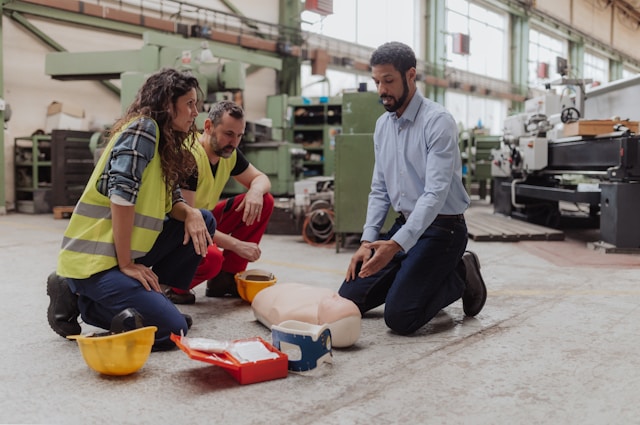
In practice, first aid training means that the business has made conscious choices around who should know what, and where the expertise is available. It is common for companies to appoint one or more first responders per department, shift or location, and ensure that they have relevant training.
Training should cover basic skills such as alerting, free airways, cardiac and pulmonary resuscitation and handling bleeding. In addition, customized training related to the risk image of the business may be needed, such as pinch and fall injuries, electrical accidents or exposure to chemicals.
Recommendations on updating and repetition
First aid knowledge is fresh. Although there is no absolute legal requirement on how often training should be repeated, it is generally recommended that first aid qualifications be updated regularly. Many businesses assume a repeat every 12 to 18 months, especially where the risk of serious injury is high.
Repetition helps not only to refresh skills, but also to increase the peace of mind of employees. It makes the threshold lower for intervening when a situation arises.
Documentation that provides peace of mind when supervising
When supervising, it is expected that the company can show how the first aid training is organized and followed up. It usually involves documentation of who has received the training, when it was carried out, and how the competence is maintained.
Just as important as the course certificate is the overview. The company should be able to quickly show how many first responders exist, where they are located, and how readiness is ensured across working hours, shifts and locations. This gives a clear picture that first aid is planned and not accidental.
Context of preparedness and other health and safety work
First aid training should not be viewed in isolation. It is closely linked to other parts of the emergency response work, such as fire protection, warning and evacuation. In many businesses, it makes sense to see these topics in context, both in training and in documentation.
When first aid is rooted in the company's risk assessments and routines, it is also easier to explain by supervision why the training is organized as it is. It shows that the company works systematically and risk-based, not just reactive.
Practical and theoretical training — two sides of the same issue
Much first aid training is conducted today as e-learning, often as part of a wider HSE run. This is well suited to cover theory and basic understanding. At the same time, it is important to be aware that practical training is often just as important for building confidence and vigor.
Therefore, many companies choose to combine e-learning with practical exercises, either physically or through simulated solutions. The most important thing is that the company can document that the training overall provides real readiness.
Common challenges related to first aid training
When an inspection reveals deficiencies in the field of first aid, it is rarely about the total absence of training. Often the challenge is a lack of overview, outdated expertise or unclear distribution of responsibilities. In some cases, it is unclear who will actually act at an incident, or whether first responders are available at all times.
Such weaknesses often arise when training is carried out as a single measure, without a clear link to role, risk and follow-up.
First aid training in the workplace is basically about preparedness. When the training is adapted to the risks of the business, updated over time and well documented, it provides both peace of mind in everyday life and predictability in supervision.
Latest Articles
MORE ARTICLES
What is a safety representative and what are the responsibilities?
All businesses with at least five employees must have a safety representative. But what exactly does a protection officer do, and what are the responsibilities in practice?

How to create a skills plan for employees
Competency development in the enterprise does not have to be complicated. With a good skills plan, you always know who knows what and what is missing.

78 million new jobs by 2030
But the skills pledge is urgent.